Chinon CE-4 - the unexpected surprise

Overview
The Chinon CE-4 is a 35mm K-mount SLR from the early 1980s that neatly bridges the gap between fully manual classics and the increasingly automated cameras that followed. Built by Chinon Industries—an OEM behind many rebranded models for department stores and other marques—the CE-4 delivers reliable aperture-priority automation alongside full manual control, wrapped in a compact, straightforward body. For photographers exploring film today, it offers an appealing mix of affordability, versatility, and the tactile engagement that defines the SLR experience.
Design and Handling
Ergonomically, the CE-4 is familiar and unfussy. A well-shaped advance lever, shutter-speed dial with a clear “Auto” position, and a bright, information-rich viewfinder make it approachable for beginners and quick for experienced shooters. The focusing screen typically includes a split-image rangefinder surrounded by microprism, aiding precise focus in low light or with slower lenses. Build quality is solid for its class: metal where it counts, plastic where it saves weight, and controls that click with confidence. It is battery-dependent for metering and electronic shutter timing, so keeping a spare set of button cells in the bag is wise.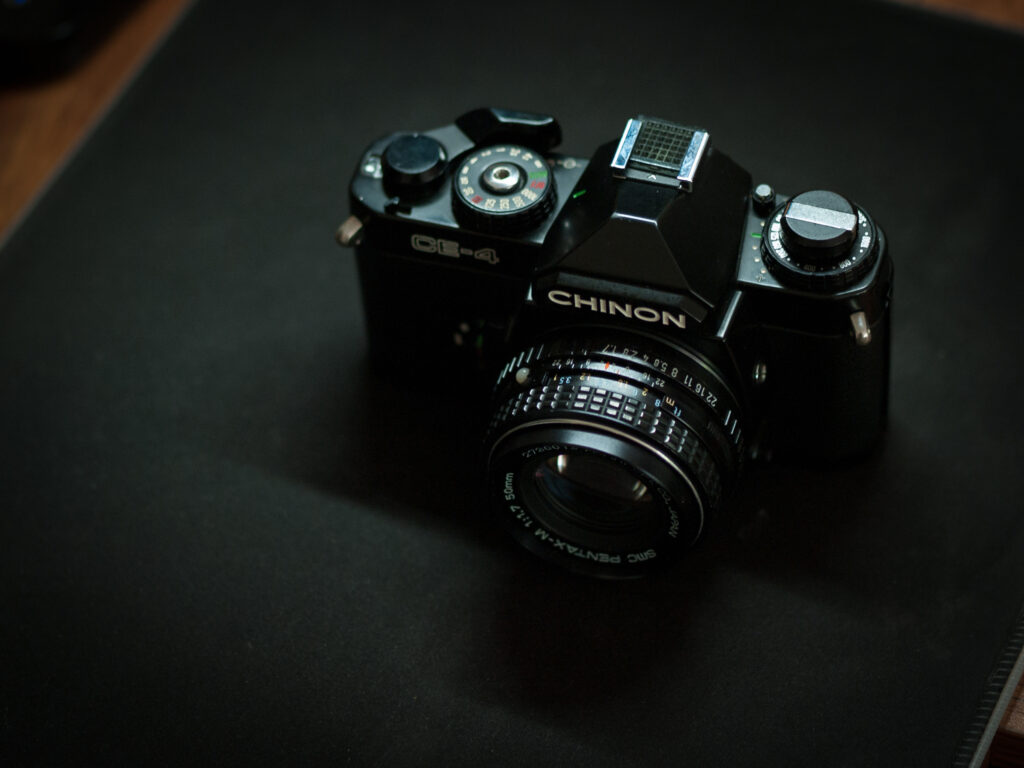
Exposure and Metering
The CE-4’s hallmark is aperture-priority auto exposure: you set the f-stop on the lens, and the camera selects an appropriate shutter speed. A clear LED display in the finder indicates the chosen speed, making it easy to anticipate motion blur or camera shake and adjust accordingly. In manual mode, those same display cues act as a guide, encouraging a smooth learning curve. Metering is center-weighted TTL—predictable, consistent, and easily finessed with exposure compensation or by metering off midtones. Many Chinon bodies from this era also include an AE lock/memory function, a practical aid for backlit scenes and high-contrast compositions.
Lens Compatibility
Because it uses the Pentax K bayonet, the CE-4 accepts a vast ecosystem of lenses—from classic Pentax-M and -A primes to third-party glass by Ricoh, Chinon, Tokina, and Vivitar. That opens the door to characterful 50mm standards, compact 28mm and 35mm walk-around lenses, and longer telephotos for portraits or wildlife. Adapters extend the palette further to M42 screwmount lenses (with stop-down metering), letting you experiment with vintage rendering at modest cost. The camera’s straightforward focusing aids and viewfinder brightness make manual-focus work satisfying and precise.
In Use
Shooting the CE-4 feels intuitive. The shutter release is responsive, the advance is smooth, and the finder information is legible without clutter. The camera rewards deliberate exposure choices: stop down for depth and crispness, open up for subject isolation and atmosphere. With negative film’s latitude, the center-weighted meter handles most situations gracefully; transparency film benefits from more careful placement, where AE lock and bracketing pay off. The self-timer, hot shoe, and cable-release socket round out a practical feature set for everyday photography.

Buying Tips and Value
As with any electronic SLR of its era, inspect light seals and mirror dampers for deteriorated foam, test metering and shutter operation at multiple speeds, and verify battery contacts are clean. The CE-4 often flies under the radar versus better-known Pentax bodies, which helps keep prices reasonable. For learners, tinkerers, or anyone curious about the K-mount ecosystem, it’s a compelling entry point.
Who It’s For
The Chinon CE-4 suits photographers who want the simplicity of aperture-priority with the control of manual exposure, access to plentiful lenses, and a dependable, no-drama shooting experience. It’s an honest, capable tool that lets the glass and the film do the talking.
0 comments
Please sign in to leave a comment.